 |
|
|
|
|
|
|
|
|
|
|
|
|
|
|
|
|
|
|
|
|
|
|
|
|
|
|
|
|
|
|
|
|
|
|
|
|
|
 |
|
|
|
 |
|
|
|
The souls of those who lost their lives seemed to remain with the ship. The oil slick on the water's surface looked like tears and blood, a reminder that the tragedy of war should never be repeated. |
|
|
|
|
|
|
|
It was 6:30 in the morning. My friends and I met our tour guide in the lobby of Park Shore Hotel located at the very eastern end of Waikiki.
We carried with us hats, umbrellas, cameras, camcorders and bottled water. As strict security measures were enforced at the destination, our tour guide told us not to bring purses, handbags, camera bags, backpacks or any items that offered concealment.
The drive from Waikiki to Pearl Harbor took about twenty minutes. When we arrived at the National Park Service parking lot, there was already a long line forming at the entrance to the Visitor's Center. We got in line at 7 a.m. Close to two hundred people were already in front of us. We were well-prepared for the wait, everyone in our group wearing comfortable shoes. Chatting and taking photos of the people standing in line, we found it easy to pass the time. By the time the Visitor's Center opened at 7:30 a.m., we could tell that about four to five hundred people were behind us. The incredibly long line for the entrance was wrapped around the block.
|
|
|
|
At the entrance, every visitor was given a souvenir ticket to see a film about the attack on Pearl Harbor and to visit the USS Arizona Memorial. We looked at our beautifully designed tickets with the number "3癳ritten on each one. Our tour guide said we were in group 3 and our 75-minute program would begin at 8:45 sharp. We were advised to use the restrooms before the program began, as there were no facilities available in the theater or on the Memorial.
|
|
|
 |
|
|
|
|
|
|
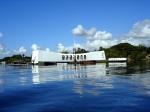
The Visitor's Center was well designed. While the outside area looked like a park, the theater, gift shop, museum and snack shop were sheltered. A gentle breeze cooled us as we walked through the facility. At the rear end of the Visitor's Center there was a large open courtyard overlooking Pearl Harbor. Gazing over the water, I saw the gleaming white Memorial in the distance. The white structure sags in the center; both ends stand strong and vigorous. I thought about what the architect of the Memorial, Alfred Preis, said. While the sag in the center stands for initial defeat, the strong ends of the Memorial represent ultimate victory. The Memorial is indeed an architectural design befitting of the importance of the site to Hawaii, the United States, and the world.
|
|
|
|
 |
|
|
|
|
|
At 8:45 a.m. we entered a small theater with a large screen. Before the movie began, a volunteer, Pearl Harbor survivor, gave a brief talk on the surprise attack. In a voice filled with emotion, he recounted the attack that caused 2,390 military personnel to perish on December 7, 1941. He said among the dead there were brothers and father and son.
It was very quiet inside the theater. Our volunteer, a person with a connection to the past, brought us back to December 7, 1941. His story gave perspective to the surprise attack; his emotions rubbed off on us.
|
|
|
 |
|
|
|
|
|
|
 |
|
|
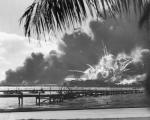
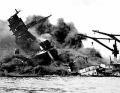
The twenty-minute documentary had actual film footage of the sinking of the battleship Arizona. A lot of tears were shed during the film, which showed the sacrifice and courage of the men under attack. When the film ended, a side door of the theater opened where a shuttle boat operated by the Navy was waiting to take us to the Arizona.
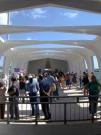
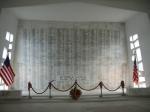
After a short ten-minute boat ride, we disembarked at a small dock leading up to the Memorial. A somber and dignified place, the Memorial stretching across the middle of the sunken ship Arizona is divided into three sections: the entry room, a central area with large open windows designed for observation, and a shrine room. Many visitors stood in the shrine room, observing a moment of silence for the men whose names were engraved on a marble wall.
|
|
|
|
|
|
|
 |
|
|
|
|
|
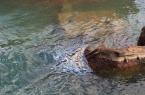
I had never seen such a quiet group of people in a public place. It was as if everyone knew that the Memorial was for quiet contemplation. Peering over the large open window, I saw the Arizona's hull under water. The ship was corroded. Parts of the ship's gun turrets rose above the water line. Oil leaked from the Arizona's engines kept floating to the surface.
I felt intense sadness, standing on the Memorial straddling the final resting place of the military personnel entombed in the wreckage of the battleship. The souls of those who lost their lives seemed to remain with the ship. The oil slick on the water's surface looked like tears and blood, a reminder that the tragedy of war should never be repeated.
A visit to the Arizona Memorial is an educational experience. After living in Hawaii for so many years, I am glad that finally I have made the emotional journey.
|
|
|
 |
|
|
|
|
|
 |
|
|
|
|
|
|
Home | Index |
|
|
|
|
|